


Irish Threepence Coin: History, Design, and Collector’s Guide
The Irish threepence coin, known in Irish as "leath reul," (meaning half a sixpence) is one of the most distinctive coins of Ireland’s pre-decimal era. Introduced in 1928 following Irish independence, it combined national symbolism, native wildlife, and Irish-language inscriptions in a way no earlier Irish coin had done.
This little coin features a distinctive Irish hare on one side and the Irish harp on the other, making it one of the most beloved pieces of Irish currency.
Small in size but rich in meaning, the threepence circulated for over forty years and remains one of the most recognisable and collectable Irish coins today.

Today, collectors treasure these coins for their historical significance and beautiful design.
For those who fancy wearing a piece of Irish history, Mintique of Cambridge transforms vintage threepence coins into stunning jewellery that keeps this heritage alive.
Irish threepence coin overview
|
Specification |
Details |
|
Country |
Ireland |
|
Issuing Authority |
Irish Free State / Ireland |
|
Years Minted |
1928 – 1968 |
|
Denomination |
Threepence (3d) |
|
Irish Name |
Leath reul |
|
Composition |
Nickel (1928–1940), Cupronickel (1942–1968) |
|
Weight |
3.24 g |
|
Diameter |
17.7 mm |
|
Shape |
Round |
|
Edge |
Smooth |
|
Mint |
Royal Mint, London |
|
Demonetised |
15 February 1971 |
The Irish threepence formed part of the first independent coinage of the Irish Free State, replacing British designs with imagery rooted in Irish culture and rural life. Worth ¼ of a shilling or 1⁄80 of a pound, it was commonly used for everyday purchases such as sweets, newspapers, and bus fares.
Unlike the British threepence, Ireland chose a round coin with a native animal motif, ensuring the denomination was immediately recognisable and culturally distinct.
Design features & symbolism
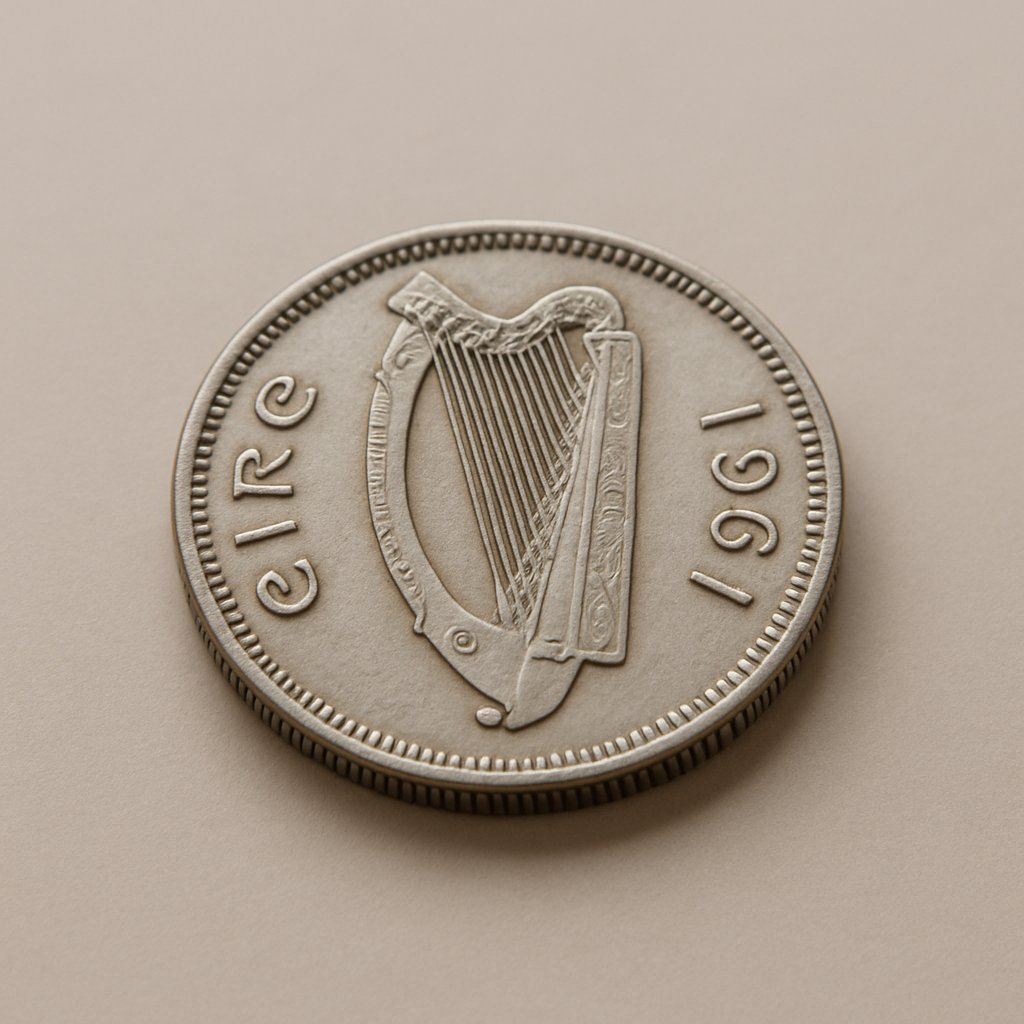
Obverse: The Irish Harp
The obverse features a stylised Irish harp, Ireland’s long-established national symbol.
-
Coins dated 1928–1937 bear the legend Saorstát Éireann (Irish Free State).
-
From 1938 onwards, this changed to Éire, reflecting constitutional developments.
The harp design is deliberately restrained, prioritising clarity and durability in circulation.
Reverse: The Irish Hare
The reverse depicts a left-facing Irish hare, rendered in a naturalistic style.
-
The denomination appears as leath reul alongside 3d.
-
The hare reflects Ireland’s rural heritage and native wildlife rather than heraldic or royal symbolism.
The choice of animal imagery marked a conscious move away from British coin traditions and helped establish a uniquely Irish visual identity.
Artist & design origins
The threepence design was executed by Percy Metcalfe, adapting concepts originally proposed by Italian sculptor Publio Morbiducci for Ireland’s first national coinage series.
Metcalfe’s challenge was to balance artistic detail with practical minting requirements, particularly on a small coin. The enduring clarity of the hare design - even on well-circulated examples - reflects the success of that balance.
Minting, metal & production
Composition changes
-
1928–1935: Struck in nickel, making the coin exceptionally hard-wearing.
-
1942 onwards: Changed to cupronickel (75% copper, 25% nickel) due to wartime metal shortages.
The shift did not affect the coin’s appearance or value in circulation.
Production notes
-
All Irish threepence coins were struck at the Royal Mint, London.
-
Production paused between 1936 and 1941, resuming during World War II.
Circulation & demonetisation
The threepence entered circulation in December 1928 and remained in everyday use until decimalisation.
Ireland adopted decimal currency on 15 February 1971. Unlike the shilling (5p) and florin (10p), the threepence had no decimal equivalent and was withdrawn immediately.
Pre-decimal and decimal coins briefly circulated together for three days before the threepence disappeared from daily use.
Collector notes
Rarity & notable years
-
Scarcer dates: 1933, 1934, and certain early Free State issues
-
Most common: 1940s–1960s issues, particularly high-mintage years such as 1942
Early Free State coins are generally more sought after than later issues.
Factors influencing value
-
Year of issue
-
Condition and remaining detail
-
Collector demand for Free State coinage
-
Provenance (for exceptional examples)
Later dates remain affordable, making the threepence an accessible entry point for collectors.
Grading & condition guide
-
Fine (F): Moderate wear; hare and harp clearly visible
-
Very Fine (VF): Light wear; fur texture and harp strings mostly defined
-
Extremely Fine (EF): Minimal wear; strong detail throughout
-
Uncirculated: No wear; original mint lustre intact
Wear typically appears first on the hare’s back and ears, and on the harp strings.
Varieties & errors
-
Minor die variations occur across years
-
Occasional off-centre strikes and die cracks are recorded
-
Dramatic errors (double strikes) are rare and command premiums
Legacy & cultural impact
The Irish threepence is remembered not only as currency, but as a symbol of early Irish statehood. Its animal-based design helped define a national coinage style that deliberately rejected imperial imagery.
The hare motif remains one of the most celebrated designs of the series and continues to inspire modern reproductions, commemorative issues, and collectible jewellery.
Today, original Irish threepence coins are increasingly preserved as wearable heirlooms, allowing their history to be enjoyed rather than forgotten. Whether displayed or worn, they remain tangible links to Ireland’s early independence and everyday life in the 20th century.
If you’re drawn to the story and symbolism of the Irish threepence, you may enjoy seeing how original Irish coins are preserved as wearable keepsakes.
→ Explore the Mintique of Cambridge Irish Coin Jewellery Collection


